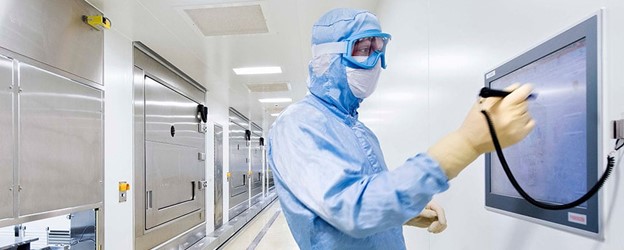
Cleanroom goggles play a critical role in contamination control and eye safety across pharmaceutical, biotech, semiconductor, and medical device environments. In GMP and ISO-classified spaces, the challenge is balancing sterility assurance with optical clarity, anti-fog performance, and material longevity. This guide outlines validated sanitization options, how to protect coatings, and how to choose a method aligned with ISO 14644 cleanroom classifications and safety standards such as ANSI Z87.1 and CSA Z94.3. Klar supplies non-ventilated, anti-fog cleanroom goggles designed for compliant reprocessing in controlled environments.
Autoclave Sterilization
Autoclaving offers high sterility assurance for goggles specifically labeled as autoclavable by the manufacturer (verify cycle parameters and track cycle counts to protect seals and coatings).
Advantages
- Sterility assurance: Achieves reliable inactivation of bacteria, viruses, and spores when validated cycles are used. – – Efficient throughput: Batches multiple items with standardized, auditable cycles.
Disadvantages
- Thermal/steam stress: Heat and moisture can degrade certain polymers, elastomers, and lens coatings over time. – – Compatibility limits: Only appropriate for goggles designed and validated for autoclave; document maximum cycle counts.
Chemical Disinfection
Chemical disinfectants are widely used in controlled environments when heat is not suitable. Choose agents compatible with lenses, frames, and straps, and follow required contact times.
Advantages
- Versatility: Can be used for a variety of materials, including those that cannot withstand high temperatures.
- Broad spectrum options: Effective formulations are available against bacteria, viruses, and fungi; suitable for frequent turnaround.
Disadvantages
- Potential for chemical residue: Improper rinsing can leave behind chemical residues that may irritate the eyes or damage the goggles.
- Risk of corrosion: Some chemicals can corrode the metal parts of the goggles.
- Coating sensitivity: Some solvents (e.g., high-IPA formulas) may shorten the life of anti-fog or hard-coat layers; verify compatibility.
Ultraviolet (UV) Germicidal Irradiation
UV-C can supplement cleaning/disinfection where line-of-sight exposure is assured; it is typically used as an adjunct step rather than the sole method for complex geometries.
Advantages
- Non-chemical method: Does not involve the use of harsh chemicals.
- Effective against a wide range of microorganisms: UV light can inactivate bacteria, viruses, and fungi.
- No moisture residue: Useful where drying is challenging.
Disadvantages
- Limited penetration: UV light may not penetrate all surfaces, especially those with complex shapes or crevices.
- Potential for damage: Overexposure to UV light can damage certain materials, such as plastics.
- Dosimetry required: Validate dose and exposure time; monitor polymer aging.
Hydrogen Peroxide Vaporization
Vaporized hydrogen peroxide (VHP/HPV) provides high-level decontamination in many controlled environments when equipment and aeration are properly validated.
Advantages
- Effective against a wide range of microorganisms: Hydrogen peroxide vapor is a powerful disinfectant.
- Safe for most materials: Generally safe for most materials, including plastics and metals.
- Dry process: No liquid residue when cycles and aeration are validated.
Disadvantages
- Requires specialized equipment: Hydrogen peroxide vaporization requires specific equipment and trained personnel.
- Potential for residue: Improperly performed sterilization can leave behind residue.
- Coating considerations: Prolonged or repeated exposure may dull some coatings; confirm compatibility and set cycle limits.
Ventilated vs Non‑Ventilated Goggles in Context
- Ventilated goggles are commonly used in construction, woodworking, and environments with larger particles. They are not typically suited for higher ISO cleanroom classes due to airflow paths that can permit particle exchange.
- Non‑ventilated goggles are preferred for chemical vapor environments, higher ISO classes, and hazardous lab conditions where splash and aerosol control are required. Reliable anti‑fog technology is essential to maintain visibility without compromising the seal.
Klaritex offers non‑ventilated, anti‑fog cleanroom goggles engineered for controlled environments and compatible with validated reprocessing protocols.
Protecting Anti‑Fog and Optical Performance
- Use approved cleaners and disinfectants; avoid abrasive media and alcohol‑heavy solutions unless explicitly permitted by the manufacturer.
- Maintain required contact times; if residue‑forming chemistries are used, rinse with WFI/DI as per SOP to prevent haze.
- Dry with non‑abrasive, low‑lint materials; inspect lenses for scratches, hazing, or coating wear.
- Control temperature exposure: follow labeled limits for autoclave/VHP to preserve anti‑fog and hard‑coat performance.
Practical SOP: Step‑by‑Step Reprocessing
1) Pre‑clean: Remove gross soil with sterile, low‑lint wipes; handle by the strap/frame to reduce fingerprints and perspiration deposits.2) Disinfect/Sterilize:
- Chemical: Apply approved agent; keep surfaces wet for labeled contact time.
- Autoclave: Load in lint‑free pouches; run validated cycle for autoclavable models; allow full drying.
- VHP: Arrange for line‑of‑sight exposure; complete aeration to safe residual levels.
- UV‑C (adjunct): Expose both sides to validated dose; avoid shadowing.
3) Rinse (if applicable): Use WFI/DI to remove residues that can irritate eyes or degrade coatings.4) Dry: Use low‑lint wipes or HEPA‑filtered drying; avoid heat exceeding material limits.5) Inspect: Check lenses (clarity, scratches, haze), frames (deformation), straps (integrity, low‑lint performance), and seals.6) Package/Label: Store in clean, lint‑free pouches; label with item ID and reprocessing date.7) Record/Trace: Document cycle counts and any defects; replace at end‑of‑life.
Choosing the Right Method
Select a method using a risk‑based framework:
- Environment: ISO 14644 classification and whether the area is aseptic per GMP Annex 1.
- Soil load/turnaround: Frequency of use and required cycle time between shifts.
- Material/coatings: Polycarbonate lenses, elastomeric frames, low‑lint straps, and anti‑fog/hard coats—verify compatibility.
- Equipment/validation: Availability of autoclave/VHP/UV‑C and validated cycles, including aeration.
- Safety/standards: Maintain compliance with ANSI Z87.1 and CSA Z94.3 for impact and splash; ensure reprocessing does not compromise protective performance.
- Lifecycle: Track cycle counts and define replacement criteria (e.g., coating haze, strap wear, seal deformation).
By applying a validated SOP and selecting the appropriate method for your environment, you can maintain the cleanliness and safety of your cleanroom goggles while preserving optical performance and user comfort. Klaritex supports EHS and quality teams with non‑ventilated, anti‑fog cleanroom eye protection and guidance on compliant reprocessing.