

In the precision-driven worlds of pharmaceuticals, biotechnology, and microelectronics, contamination control is non-negotiable. However, as industries strive for ISO 14644 compliance, a silent crisis has emerged in the waste stream. The environmental impact of disposable cleanroom PPE is no longer a peripheral concern it is a central operational challenge for facility managers and procurement specialists alike.
For decades, the default solution for maintaining sterility was single-use plastics. The logic seemed sound: use it once, discard it, and eliminate the risk of cross-contamination. Yet, when we apply rigorous Life Cycle Analysis (LCA) standards like ISO 14040, the data reveals a different story. The cumulative effect of millions of disposable garments entering landfills annually is not just an ecological burden; it represents a massive inefficiency in resource utilization.
At Klaritex, we have analyzed the shift from linear consumption models to circular economy principles. This article dissects the hard data behind disposable vs. reusable PPE, providing the evidence needed to make informed, sustainable decisions without compromising the integrity of your cleanroom.
Quantifying the Carbon Footprint: Disposable vs. Reusable
To understand the magnitude of the issue, we must look beyond the disposal bin. A comprehensive Cradle-to-End-of-Life (CTEOL) analysis tracks the environmental cost from raw material extraction (often petroleum for polypropylene disposables) to incineration or landfill.
Research indicates that the carbon footprint of disposable PPE is significantly higher than that of reusable alternatives. A study by Prudential Uniforms found that reusable cleanroom garments offer a 27% smaller carbon footprint than their disposable counterparts. When we scale this up to a facility using thousands of coveralls per month, the carbon savings become a critical component of ESG reporting.
Comparative Life Cycle Metrics
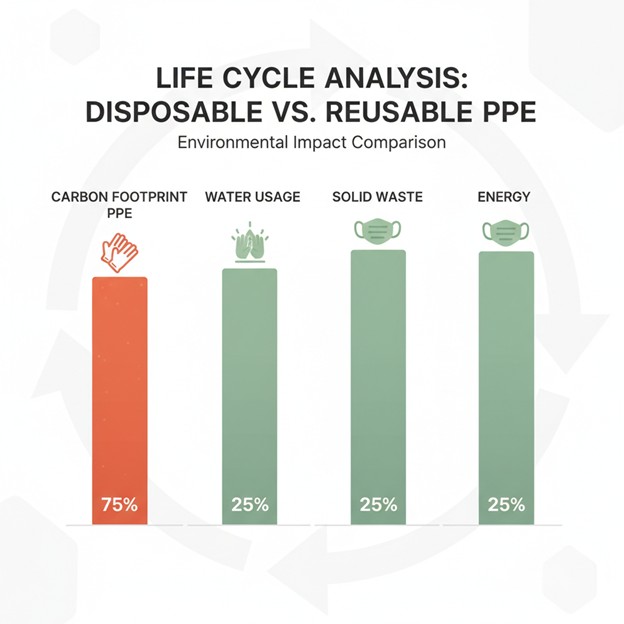
The following table breaks down the environmental performance of disposable versus reusable cleanroom garments over a standard service life (typically 50+ cycles for reusables).
| Impact Category | Disposable PPE (Non-woven Polypropylene) | Reusable PPE (Woven Polyester) | Environmental Savings with Reusables |
| Carbon Footprint | High (Single-use manufacturing) | Low (Amortized over 50-70 cycles) | 27% – 58% reduction |
| Water Consumption | High (Manufacturing intensive) | Moderate (Laundering process) | 73% – 77% reduction |
| Solid Waste | 100% volume to landfill/incineration | <10% volume (End-of-life only) | 93% reduction |
| Process Energy | High (Continuous production) | Low (Cleaning & Sterilization) | 34% – 59% reduction |
Data synthesized from Micronclean, Prudential Uniforms, and ARTA studies.
Water Usage and Energy Consumption
One of the most surprising findings in recent LCA studies is the water footprint. It is a common misconception that laundering reusable garments consumes more water than manufacturing disposables. However, the production of non-woven polypropylene fabrics is incredibly water-intensive.
According to a Micronclean study, validated reusable cleanroom garments reduce the water footprint by 77% over 50 cycles compared to disposables. For facilities located in water-stressed regions, this metric alone can drive the decision to switch.
Similarly, energy consumption favors reusables. While sterilization processes (such as autoclaving) do require energy, they pale in comparison to the energy required to extract oil, refine it into plastic pellets, melt-blow fabric, construct a garment, package it, and ship it globally—only for it to be used for a few hours. Reusables effectively cut process energy by nearly 60%.
The Landfill Crisis: Plastics and Microplastics
The volume of physical waste generated by cleanrooms is staggering. In a typical scenario, a single operator might discard a coverall, hood, boot covers, and mask every shift. Over a year, this accumulates into tons of non-biodegradable waste.
Microplastic Shedding and Pollution
The impact extends beyond the landfill. Disposable PPE is primarily made from non-woven polypropylene. As these materials degrade—or even during use—they can shed microplastics. A 2021 NIH review highlights that the surge in single-use PPE production has significantly increased plastic pollution globally, overwhelming waste management infrastructure.
Conversely, the American Reusable Textile Association (ARTA) reports that switching to reusables can cut solid waste to landfill by 93%. This is achieved because a single reusable garment replaces roughly 50 to 70 disposable ones. When the reusable garment finally reaches its end of life, it is often downcycled or recycled, whereas contaminated disposables are frequently incinerated, releasing further emissions.
Standards and Compliance: ISO and GMP
A primary concern for Quality Assurance (QA) managers is whether reusables can maintain the same strict contamination control as disposables. The answer lies in the material science and validation protocols.
Material Integrity Comparison
- Disposable Fabrics: typically Flashspun High-Density Polyethylene (HDPE) or Spunbond-Meltblown-Spunbond (SMS) Polypropylene. These are excellent barriers but are fragile and prone to tearing if reused.
• Reusable Fabrics: Woven monofilament polyester with carbon grids for static dissipation. These are engineered to withstand rigorous cleanroom disinfection methods without shedding particulates.
Studies confirm that reusable sterile garments exceed 50 decontamination cycles while fully meeting ISO 14644 particulate standards. This ensures that the environmental benefits do not come at the cost of product quality.
Economic Implications of Sustainability
Sustainability is often viewed as a cost center, but in the case of cleanroom PPE, it is a cost saver. The “cost per use” model demonstrates that while the upfront investment for reusable gear is higher, the long-term savings are substantial.
- Disposal Costs: Hazardous or controlled waste disposal is expensive. Reducing waste volume by 93% drastically lowers these fees.
- Inventory Management: Reusables stabilize supply chains. You are less vulnerable to global shortages of raw polypropylene, a lesson learned painfully during the pandemic.
- Lifecycle ROI: A Prudential Uniforms LCA reported that reusables can decrease disposal costs by over 50% compared to single-use uniforms.
For a deeper dive into the trade-offs between different garment types, we recommend reviewing our analysis on disposable vs reusable cleanroom garments, which breaks down the operational differences in detail.
Strategic Implementation: Making the Switch
Transitioning from disposable to reusable PPE requires a calculated approach. It involves updating Standard Operating Procedures (SOPs) and validating new vendors. However, the path is well-trodden by major pharmaceutical and technology firms.
Steps to Reduce Environmental Impact
- Conduct an Internal Audit: Calculate your current waste volume in kg/year. Use this as a baseline for your ESG goals.
• Start with Non-Sterile Areas: CNC and packaging areas often have lower classification requirements (e.g., ISO 7 or 8), making them ideal pilot zones for reusable cleanroom apparel and protective gear.
• Partner with Specialized Laundries: Ensure your laundry provider adheres to ASTM and IEST standards for particulate removal and sterilization.
• Evaluate Ancillary Items: Don’t stop at coveralls. Goggles, hoods, and boots also have reusable options that contribute to waste reduction.
According to the UCL LEAF framework, laboratories that adopt reusable PPE and waste reduction strategies can save millions annually while significantly cutting CO2 emissions. This proves that high-tech environments can lead the way in sustainability.
FAQ: Environmental Impact of Cleanroom PPE
What is the carbon footprint difference between disposable and reusable PPE?
Reusable cleanroom garments generally offer a 27% to 58% reduction in carbon footprint compared to disposables, primarily due to the energy-intensive manufacturing process required for single-use items.
How much water do disposable cleanroom garments consume?
While laundering reusables uses water, the manufacturing of disposable plastics is far more water-intensive. Studies show reusables can reduce the overall water footprint by approximately 77% over their lifecycle.
Do reusable garments meet the same safety standards as disposables?
Yes. When managed correctly, reusable woven polyester garments meet rigorous ISO 14644 particulate standards and can withstand 50+ sterilization cycles without compromising barrier performance.
How does cleanroom PPE contribute to microplastic pollution?
Disposable PPE is often made of non-woven polypropylene. When these items are discarded or incinerated, they can release microplastics into the environment. Reusables, being woven and durable, shed significantly fewer particles during their lifecycle.
Can I use reusable PPE in an ISO Class 5 cleanroom?
Absolutely. Reusable garments are the standard in many ISO Class 5 (Grade A/B) pharmaceutical environments, provided they are sterilized via validated autoclave or gamma irradiation processes.
Conclusion
The data is unequivocal: the environmental impact of disposable cleanroom PPE is a burden that modern industries can no longer afford to ignore. By shifting to validated reusable systems, facilities can achieve a “triple win”: reducing carbon emissions, cutting operational costs, and maintaining the highest standards of contamination control.
At Klaritex, we believe that the future of cleanroom technology is not just about protection—it is about responsible innovation. As you evaluate your facility’s footprint, consider the lasting impact of the gear you choose every day.